

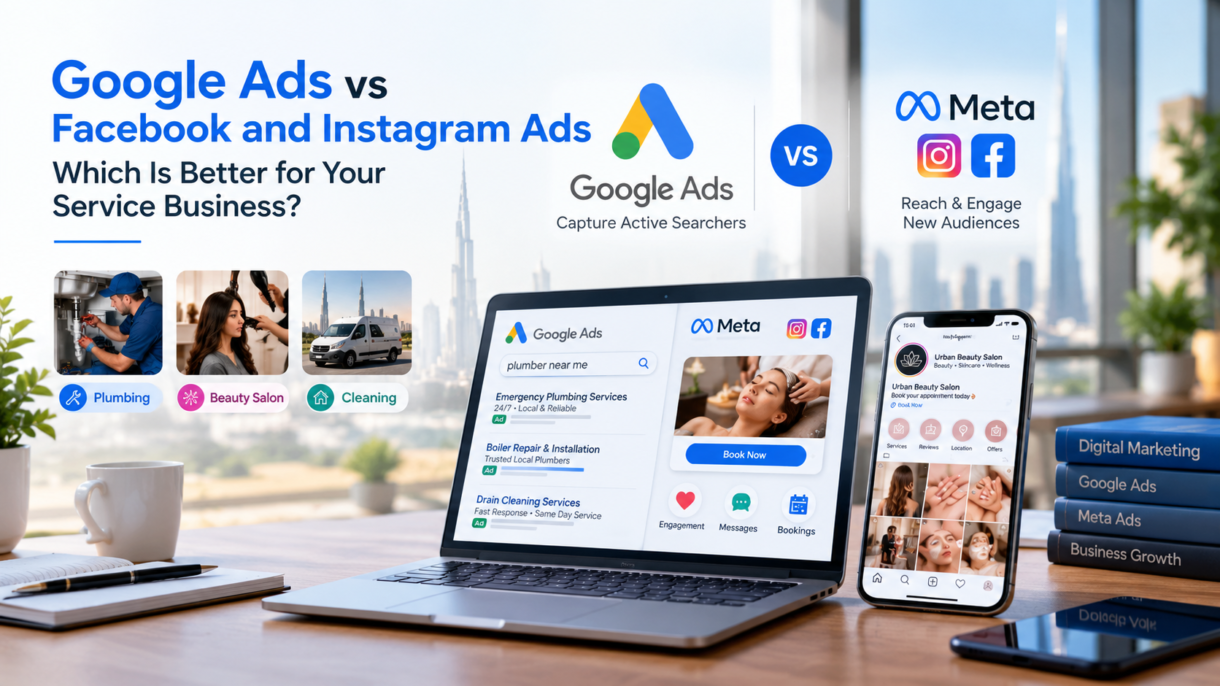

Google Ads or Meta Ads for your service business? Learn the differences, compare costs and lead quality, and choose the right advertising strategy for your goals.
If you own a plumbing company, beauty salon, cleaning business, or another service-based business, you’ve probably wondered where you should invest your advertising budget.
Should you use Google Ads to reach people searching for your services? Or should you advertise on Facebook and Instagram to introduce your business to potential customers?
Both approaches can generate enquiries, but they work differently. Choosing the right platform depends on your services, target audience, budget, location, and how customers make purchasing decisions.
For some businesses, Google Ads may be the best starting point. For others, Meta Ads may offer a better way to showcase services and generate interest. In certain situations, combining both platforms can create a stronger marketing strategy.
In this guide, we’ll compare Google Ads and Meta Ads, explain when each works best, and show you how to make a more informed decision for your service business.
1. What Is the Difference Between Google Ads and Meta Ads?
The biggest difference is how the two advertising platforms help you reach potential customers.
Google Ads: Reach People Who Are Searching
Google Ads can place your business in front of people searching for relevant services on Google and, depending on the campaign type, other Google advertising placements.
For example, someone searching for “emergency plumber in Birmingham” is actively looking for a solution.
A plumbing company with a relevant Google Search campaign may be able to reach that person when they need the service.
Google Ads can be particularly useful for businesses that serve customers with a clear, immediate need.
Examples include:
-
Emergency plumbing and leak repairs
-
Boiler servicing and repair
-
Cleaning services
-
Electrical repairs
-
Certain beauty treatments that customers actively search for
-
Professional services with clear search demand
The key advantage is that you can reach people based on relevant search intent. However, appearing in search results does not guarantee a click, enquiry, or booking.
Meta Ads: Reach People Through Discovery and Interest
Meta Ads allow eligible advertisers to reach audiences across Facebook, Instagram, Messenger, and other available placements.
Unlike a Google Search campaign, a typical Meta campaign does not require someone to search for your service at that moment.
Instead, you can introduce your business to relevant audiences through engaging images, videos, offers, and other creative content.
For example, a beauty salon in Dubai could use Instagram Reels to showcase a hair treatment, highlight the salon experience, and invite potential customers to enquire or book.
Meta Ads can be useful for:
-
Beauty salons and nail studios
-
Hairdressers and spas
-
Businesses with visually appealing services
-
Brands introducing new services or offers
-
Local businesses looking to build awareness and generate enquiries
-
Businesses that benefit from repeat purchases or customer relationships
The key advantage is the ability to showcase your service visually and reach prospective customers who may not yet be actively searching for it.
2. Google Ads vs Meta Ads: A Quick Comparison
| Factor | Google Ads | Meta Ads |
|---|---|---|
| Main opportunity | Capture existing search demand | Generate interest and reach relevant audiences |
| Typical starting point | A relevant search query | An image, video, or advertisement |
| Creative requirements | Strong keywords, ad copy, and landing pages | Strong visuals, messaging, and creative testing |
| Best measurement focus | Qualified leads, calls, bookings, and cost per conversion | Qualified leads, bookings, customer acquisition cost |
| Useful for | Services people actively search for | Visual services, discovery, offers, and audience development |
| Main challenge | Competition for valuable search terms | Turning attention and engagement into real customers |
Neither platform is automatically cheaper or better. Performance depends on your market, competition, campaign setup, creative quality, conversion experience, and sales follow-up.
3. When Should a Plumbing Business Use Google Ads?
Let’s consider a plumbing company serving Birmingham in the UK or a local service area in the USA.
When a customer has a leaking pipe, blocked drain, or another urgent plumbing problem, they may search online for a nearby professional.
This makes Google Search Ads worth considering because the customer is already expressing a relevant need.
A practical example
Suppose a plumbing company wants more enquiries for drain cleaning.
A focused Google Ads campaign could target relevant searches within its actual service area and direct visitors to a dedicated drain-cleaning page.
That page should explain the service, service coverage, contact options, and how to request assistance.
The company can then measure phone calls, completed enquiry forms, and qualified leads.
What plumbing companies should consider
-
Target services that the business actually provides.
-
Focus on the locations the company can realistically serve.
-
Use relevant keywords and appropriate negative keywords.
-
Create landing pages that match the advertised service.
-
Track qualified enquiries and booked jobs.
-
Review lead quality, not just clicks.
For services with strong existing search demand, Google Ads can be a sensible starting point.
However, high competition and expensive clicks can make campaigns unprofitable if the business attracts irrelevant traffic or fails to convert enquiries into customers.
4. When Should a Beauty Salon Use Meta Ads?
Consider a beauty salon in Dubai offering hair treatments, manicures, facials, or other suitable beauty services.
Potential customers may discover the salon while browsing Instagram, watching Reels, or viewing content from local businesses.
This creates an opportunity to showcase the salon’s work and encourage people to learn more or make an appointment.
A practical example
A salon wants to promote a specific hair treatment.
It could create a short video demonstrating the treatment process, show genuine results with customer permission, explain the service, and invite viewers to enquire through an available messaging destination or booking page.
The campaign should focus on a clearly defined service and a realistic audience within the salon’s service area.
What beauty businesses should consider
-
Use high-quality, genuine photographs and videos.
-
Demonstrate services and explain what customers can expect.
-
Make pricing and offer terms clear.
-
Use a simple booking or enquiry process.
-
Track confirmed appointments and advertising costs.
-
Follow applicable advertising rules, particularly for medical aesthetics and treatment-related claims.
Meta Ads can be particularly useful when the visual presentation of a service helps customers understand its value.
But attractive content alone does not guarantee bookings. The offer, targeting, response time, pricing, and booking experience also matter.
5. Which Platform Is More Cost-Effective?
This is one of the most common questions business owners ask, and the answer depends on what you measure.
Comparing platforms using cost per click alone can be misleading. A cheaper click does not necessarily produce a cheaper customer.
Instead, compare the cost of generating qualified enquiries and acquiring actual customers.
Example: Comparing two advertising campaigns
Imagine a business tests both platforms with the same advertising budget.
<box border radius=”xl” padding={3} gap={3}>
<grid columns={2} gap={3}>
<grid-item>
<box background=”surface-secondary” radius=”lg” padding={3} gap={1}>
<text color=”secondary” size=”sm”>Google Ads</text>
<title size=”xl” color=”default”>20</title>
<text size=”sm”>Qualified enquiries</text>
<divider color=”subtle”/>
<title size=”lg”>$25</title>
<text color=”secondary” size=”xs”>Cost per enquiry</text>
</box>
</grid-item>
<grid-item>
<box background=”surface-secondary” radius=”lg” padding={3} gap={1}>
<text color=”secondary” size=”sm”>Meta Ads</text>
<title size=”xl” color=”default”>40</title>
<text size=”sm”>Qualified enquiries</text>
<divider color=”subtle”/>
<title size=”lg”>$12.50</title>
<text color=”secondary” size=”xs”>Cost per enquiry</text>
</box>
</grid-item>
</grid>
<text color=”secondary” size=”xs”>Illustrative example only. These figures are hypothetical and do not represent typical or guaranteed campaign results.</text>
</box>
In this hypothetical example, Meta Ads generates more enquiries at a lower cost per enquiry. However, suppose the Google Ads enquiries are more likely to become paying customers, or they generate higher-value jobs.
The platform with the lowest cost per enquiry may not be the platform with the lowest customer acquisition cost.
To make a meaningful comparison, track:
-
Advertising spend
-
Qualified enquiries
-
Confirmed bookings or jobs
-
Cost per acquired customer
-
Revenue generated
-
Profitability after relevant business costs
The goal is not simply to generate the most leads. It is to acquire suitable customers at an economically sustainable cost.
6. Should You Use Google Ads and Meta Ads Together?
For some businesses, the strongest approach is not choosing one platform permanently. It is using each platform for a clear purpose.
Google Ads can help capture people who are actively searching for a service, while Meta Ads can introduce the business to new audiences, showcase its work, and support follow-up marketing where appropriate.
A simple combined strategy
Step 1: Capture existing demand
Use relevant Google Search campaigns to reach people searching for services your business provides.
Step 2: Build interest through Meta
Promote useful content, service demonstrations, and suitable offers to relevant local audiences.
Step 3: Improve the conversion experience
Send visitors to relevant service pages, enquiry forms, messaging destinations, or booking systems.
Step 4: Measure outcomes
Track qualified leads, bookings, customer acquisition costs, and revenue where possible.
Step 5: Allocate budget based on evidence
Invest more in campaigns that consistently deliver suitable customers, while testing opportunities to improve weaker campaigns.
Your business does not need to use both platforms from day one. If your budget is limited, starting with the channel that best matches your customers’ behaviour may be more practical.
7. Don’t Ignore Your Website and Conversion Tracking
Even a well-targeted advertising campaign can struggle if the website or booking process creates friction.
Imagine paying for visitors to reach your website, only for them to discover that your contact information is difficult to find or the page does not explain the advertised service.
You may lose opportunities that your advertising budget has already paid to generate.
Before scaling your campaigns, check that:
-
Your website works properly on mobile devices.
-
The landing page matches the advertisement.
-
Your services, service areas, and prices where applicable are clear.
-
Contact buttons and forms work correctly.
-
Your business responds to enquiries promptly.
-
Important conversions are tracked accurately.
-
You can distinguish qualified leads from irrelevant enquiries.
Tools such as Google Analytics, Google Ads conversion tracking, and Meta Pixel with the Conversions API can help measure relevant activity when correctly configured.
Tracking should respect applicable privacy requirements, consent obligations, and platform policies. Avoid counting every page visit or button click as a completed sale.
8. How to Choose the Right Advertising Platform for Your Business
Before launching a campaign, answer five questions.
1. Are people already searching for your service?
If customers frequently search for your service with clear intent, Google Search Ads may be a sensible place to begin.
2. Does your service benefit from visual demonstrations?
If customers respond to seeing treatments, finished work, or the experience of using your service, Meta Ads may be a strong option.
3. What is the value of a new customer?
Consider your average sale, repeat business, operating costs, and the amount you can sustainably spend to acquire a customer.
4. Can you handle the enquiries?
Generating more leads will not help if your team cannot respond quickly, qualify prospects, or deliver the service.
5. Can you measure actual results?
Set up appropriate conversion tracking and a way to record which enquiries become paying customers.
Your answers should guide your advertising decisions more than platform popularity or generic claims about which channel is best.
Final Thoughts
Google Ads and Meta Ads can both help service businesses attract customers, but they address different parts of the customer journey.
Google Search Ads can be particularly valuable when people are actively looking for a service. Meta Ads can be effective for showcasing visual services, introducing a business to potential customers, and generating interest.
For a plumbing company, Google Search Ads may be a logical first test. For a beauty salon in Dubai, Meta Ads may offer a compelling way to showcase treatments and encourage appointments. Other businesses may benefit from a combination of both.
The right strategy starts with understanding your customers, defining your business goals, and measuring the outcomes that matter.
Rather than asking which platform is universally better, ask which platform is most likely to generate profitable customers for your particular service, location, and budget.
Need Help Choosing the Right Advertising Strategy?
If you’re a service business owner looking to attract more qualified enquiries, improve your website, or make better use of your advertising budget, I can help you assess your current marketing setup and identify practical opportunities for improvement.
My services include Meta Ads, Google Ads, digital marketing strategy, and website development.
The objective is to build a marketing system that connects the right audience with the right offer and makes it easier for potential customers to contact your business.
Let’s discuss your business goals.
You can also explore my website to learn more about my digital marketing and web development services.