

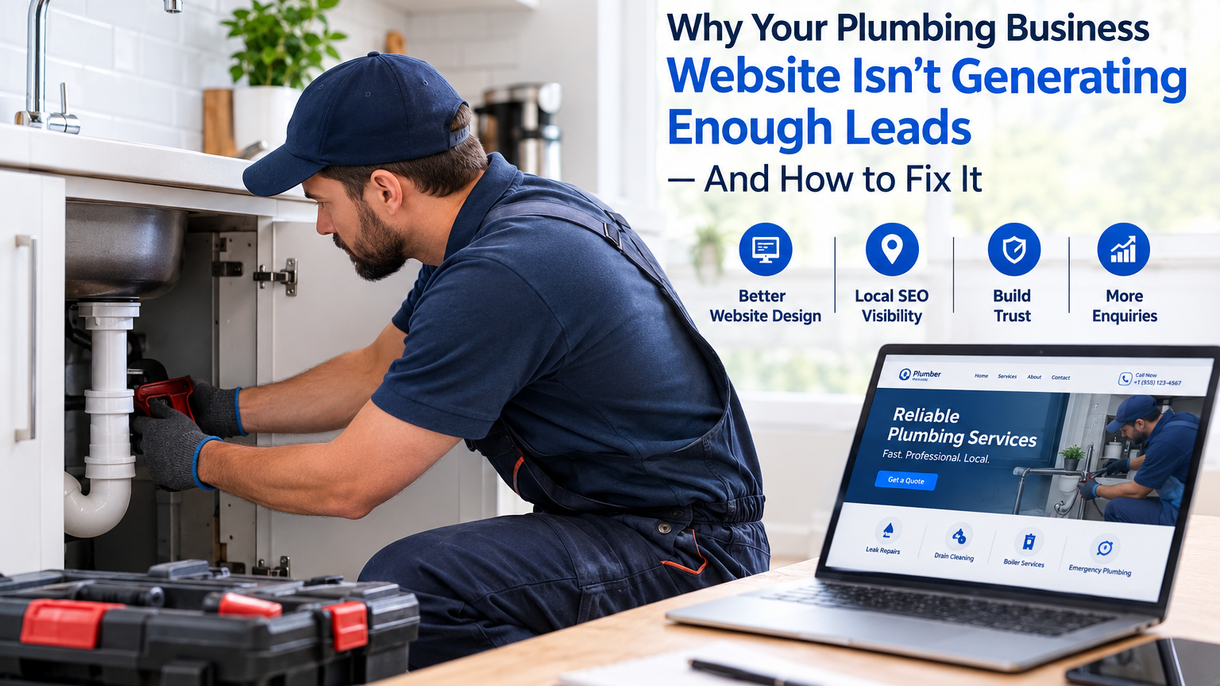

Your plumbing business may offer excellent service, employ experienced professionals, and have satisfied customers. But if your website isn’t generating enough calls, quote requests, or enquiries, you’re potentially missing opportunities to win new jobs.
For many plumbing companies in the UK and USA, a website is more than an online brochure. It is an important part of the customer acquisition process. When someone needs a plumber, they often search online, compare a few businesses, and contact the company that appears trustworthy, relevant, and easy to reach.
If your website attracts visitors but fails to turn them into enquiries, the problem may not be your plumbing services. It could be the way your website presents those services and guides visitors towards taking action.
The good news is that several practical improvements can make your website more useful to potential customers and help you measure whether your marketing is working.
In this guide, we’ll explore seven common reasons plumbing websites underperform and how to address them.
1. Your Website Doesn’t Make It Easy to Contact You
Imagine a homeowner discovering a leaking pipe. They search for a local plumber on their phone and visit your website.
They need to find three things quickly:
- What plumbing services you provide
- Whether you cover their area
- How to contact you or request assistance
If visitors have to search through several pages to find your phone number, they may leave and contact another company.
How to fix it
Make contacting your business straightforward.
- Display your phone number prominently in the header.
- Add a clear “Call Now” button for mobile visitors.
- Include a visible “Request a Quote” button.
- Provide a simple enquiry form.
- Make your service areas easy to find.
- Explain your opening hours and emergency availability accurately.
Your website should guide visitors towards one clear next step instead of making them work to discover how to contact you.
2. Your Website Is Slow or Difficult to Use on Mobile
Many customers search for local plumbing services using smartphones. A website that loads slowly, displays poorly on smaller screens, or contains difficult-to-use buttons can create unnecessary friction.
Visitors may leave before they even read about your services.
How to fix it
Start by testing your website on a real smartphone and checking its performance with Google PageSpeed Insights.
Pay attention to:
- Page loading speed
- Image file sizes
- Mobile layout and text readability
- Button size and spacing
- Navigation and contact accessibility
- Unnecessary scripts, animations, and plugins
Use appropriately compressed images and a responsive layout. Keep the most important information near the top of the page.
A mobile-friendly website should make it easy for someone to understand your services and contact you without zooming in or navigating complicated menus.
3. Your Website Doesn’t Build Enough Trust
Plumbing customers are inviting someone to work in their home or commercial property. Before making contact, they want confidence that the company is legitimate, competent, and dependable.
A generic website with little business information may not give them that confidence.
How to fix it
Show genuine evidence of your business’s credibility.
Consider adding:
- Real photographs of your team and completed jobs
- Genuine customer reviews and testimonials
- Relevant qualifications, licences, and insurance information
- Clear descriptions of your services
- Your service locations and business contact details
- Examples of completed projects
- Accurate information about warranties or guarantees, where applicable
If your business offers emergency plumbing, explain your actual availability. If you offer same-day appointments, state the conditions under which they are available.
Avoid invented testimonials, misleading badges, or promises you cannot consistently deliver.
Trust is built through clear information and evidence, not simply attractive design.
4. Your Website Doesn’t Explain Your Services Clearly
A potential customer searching for a boiler repair may have different needs from someone looking for a bathroom installation or a leaking tap repair.
If your website lists every service in one short paragraph, visitors may struggle to determine whether you can solve their particular problem.
How to fix it
Organise your website around the services you actually provide.
Depending on your business, you might create separate pages for:
- Emergency plumbing
- Leak detection and repairs
- Drain cleaning and blockage removal
- Boiler and heating services, where qualified and applicable
- Bathroom plumbing and installations
- Commercial plumbing
- Water heater installation and repair
Each service page should explain what the service includes, which locations you cover, what customers can expect, and how they can request a quote.
Avoid creating dozens of nearly identical pages with only the town name changed. Every page should offer useful, specific information.
5. Your Website Isn’t Optimised for Local Searches
A well-designed website cannot generate consistent organic enquiries if potential customers struggle to find it.
For plumbing companies, local search visibility can be particularly important because customers generally need a provider who serves their area.
How to fix it
Start with the fundamentals of local SEO.
Optimise your Google Business Profile. Keep your business information, categories, service areas, opening hours, and contact details accurate.
Use relevant local keywords. Include your actual service areas naturally in your website content. For example, a plumbing company serving Manchester might have a useful page about its plumbing services in Manchester.
Create useful service pages. Explain the specific work you perform rather than relying on a single generic services page.
Encourage genuine reviews. Ask satisfied customers to share honest feedback and respond professionally to reviews.
Keep your business information consistent. Your business name, phone number, and other important details should be accurate across your website and relevant business listings.
Local SEO takes time, and results depend on competition, location, website quality, and other factors. However, these fundamentals help search engines and potential customers understand your business.
6. You’re Running Google Ads Without a Proper Landing Page
Paid advertising can bring relevant visitors to your website, but a click alone does not guarantee a customer.
Suppose someone clicks an advertisement for emergency leak repair and lands on a generic homepage that mainly discusses bathroom renovations. The visitor may not immediately see the information they expected.
That mismatch can waste advertising spend.
How to fix it
Make sure your advertising and landing page work together.
For example, a Google Ads campaign promoting drain cleaning should lead to a page that clearly explains your drain cleaning service.
A useful landing page should include:
- A headline that matches the advertised service
- A clear explanation of the service
- The locations you cover
- Relevant trust signals
- A prominent phone or enquiry button
- A short quote-request form
- Accurate information about availability
Track phone calls, completed enquiry forms, and other meaningful conversion actions where possible.
For eligible plumbing businesses in the USA, Google Local Services Ads may also be worth investigating. Availability and eligibility vary by market and business category.
Remember that advertising performance depends on several factors, including competition, targeting, budget, the offer, and how quickly your business responds to enquiries.
7. You’re Not Tracking Where Your Enquiries Come From
If you receive a new customer enquiry, can you tell whether it came from Google Search, an advertisement, your website, or a referral?
Without reliable tracking, it becomes difficult to understand which marketing activities are contributing to business growth.
How to fix it
Set up a straightforward measurement process.
Track the following where practical:
- Website visitors from relevant marketing channels
- Phone calls generated by your website or campaigns
- Completed quote-request forms
- Qualified enquiries
- Appointments and booked jobs
- Advertising spend
- Cost per qualified lead
- Revenue attributed to marketing, where measurable
Google Analytics and Google Ads conversion tracking can help you understand website activity and campaign outcomes when correctly configured. Call-tracking tools may also be useful, provided they are implemented appropriately.
Do not judge a campaign solely by clicks or impressions. A campaign that attracts fewer but better-qualified enquiries may be more valuable than one that produces large amounts of low-quality traffic.
A Simple Checklist for Improving Your Plumbing Website
Before investing more money in advertising, review your current website against this checklist.
- Your phone number is easy to find.
- Your website works properly on mobile devices.
- Your main services are clearly explained.
- Your service areas are accurate and visible.
- You display genuine reviews and business credentials.
- Visitors can request a quote without unnecessary steps.
- Your website has relevant, useful local content.
- Your advertising links to appropriate service pages.
- Important calls, forms, and bookings are tracked.
- You have a process for responding to new enquiries promptly.
You don’t necessarily need to rebuild your entire website. Sometimes, improving a few critical pages, simplifying the contact process, and correcting tracking issues can be a sensible starting point.
The important thing is to identify the real problems before deciding where to invest.
Should You Redesign Your Plumbing Website?
A redesign may be worth considering if your current website is outdated, difficult to navigate, poorly suited to mobile devices, or unable to support your marketing goals.
However, a new design alone is not a guarantee of more leads.
The strongest approach combines a professional website with clear service information, local search optimisation, appropriate advertising, conversion tracking, and a reliable enquiry-handling process.
Your website should work as part of a broader system that helps potential customers discover your business, understand what you offer, and contact you with confidence.
Final Thoughts
Your plumbing website should do more than establish that your business exists. It should help potential customers understand your services, trust your company, and take the next step.
If your website isn’t generating enough enquiries, begin by reviewing its mobile experience, contact options, service pages, trust signals, local SEO, and conversion tracking.
Then prioritise improvements based on what you discover rather than making changes without a clear objective.
A more effective website, supported by a thoughtful marketing strategy, can give your plumbing business a stronger foundation for attracting and managing new enquiries.
Need Help Improving Your Business Website?
If you’re a plumbing company owner looking to improve your online presence, website experience, or digital advertising strategy, I can help you assess your current setup and identify practical opportunities for improvement.
I provide web development and digital marketing services focused on helping businesses build a professional online presence and create better pathways from website visits to customer enquiries.
Let’s discuss your project.
You can also explore my website to learn more about my web development and digital marketing services.